Maroon Mercury sedan in the Hoffa disappearance
I Heard You Paint HousesThe Maroon Mercury sedan in the Hoffa disappearance is at once the vehicle in Frank Sheeran’s account of Jimmy Hoffa’s last ride and a repository of forensic evidence that gave that account unusual material support. Sheeran said that he lured Hoffa into the rear passenger seat, contrary to Hoffa’s insistence on riding in front; years later, a hair recovered from the rear-seat headrest was identified as Hoffa’s. The car thus connects a disputed confession to a specific, preserved trace from the vehicle itself.
The Car in Sheeran’s Account
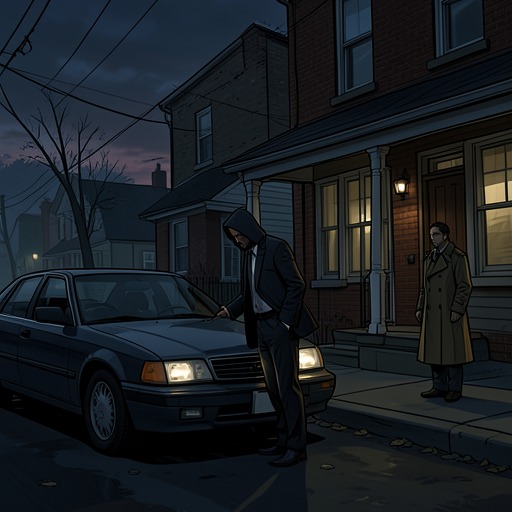
In an interview in 1999, Sheeran told Charles Brandt that he had lured Hoffa into the rear passenger seat of the maroon Mercury. The detail mattered because Hoffa, according to Brandt’s account, always insisted on taking the front passenger seat, or shotgun. The claimed change of seat was not incidental: in Sheeran’s version, the rear seat was where Hoffa entered the car before disappearing.
The Mercury was driven by Hoffa’s foster son, Chuckie O’Brien. O’Brien denied that Hoffa had been in the car and passed a lie detector test. Sheeran described O’Brien as an innocent dupe who believed he was taking Hoffa to a mob meeting, rather than knowingly helping to lure him into a trap. Brandt wrote that the Federal Bureau of Investigation had already undermined O’Brien’s alibi, which he regarded as additional support for Sheeran’s account. The car’s place in the story therefore involved competing claims about both who rode in it and what its driver understood.
The Hair and Its Preservation
A hair recovered from the headrest of the rear passenger-side seat became the sedan’s most consequential physical trace. On September 7, 2001, the Federal Bureau of Investigation announced that DNA testing had identified it as Hoffa’s. The identification linked Hoffa to the precise part of the car where Sheeran said he had placed him, though it did not by itself establish what happened during the ride or prove every part of the confession.
The hair had survived because of a legal dispute over the search of the Mercury. In 1975, Stan Hunterton, then a young assistant U.S. attorney in Detroit, drafted the search warrant. He later wrote Brandt that he had successfully argued against a mob lawyer’s motion to have the hair, along with anything else seized from the car, returned to its owner. Its preservation allowed DNA science to identify it decades later. The evidence’s force thus depended not only on the object’s discovery, but also on an earlier decision to keep it from being returned.
Corroboration and the Book’s Argument
Brandt treated the DNA result as corroboration of Sheeran’s account, alongside the account of the ride and the problems he saw in O’Brien’s alibi. He stated that, in his view as a former homicide prosecutor, the confession and the hair would have been enough to convict. That is Brandt’s assessment of the evidence, not a finding by a court: the supplied account describes no trial in which the evidence was tested against Sheeran.
The book’s record of the confession also accumulated over time rather than arriving as a single, isolated statement. Brandt first interviewed Sheeran in 1991, but Sheeran ended that session after disclosing more than he was comfortable with. The questioning resumed after a later meeting and continued for four years. Sheeran read and approved each chapter and then reviewed the complete manuscript. About two years into the renewed interviews, after he had admitted to Brandt that he was the shooter but before they went to Detroit to find the house, Sheeran told Fox News correspondent Eric Shawn that he had shot Hoffa twice in the back of the head. These stages document the development and later public endorsement of Sheeran’s claim; they do not make the car itself proof of every detail.
From Vehicle to Evidentiary Object
In the book’s construction, the Mercury changes from a means of transportation into a physical witness. Sheeran’s account gives the rear seat a specific role in the disappearance; the preserved hair ties that seat to Hoffa; and the fight to retain the hair explains why the connection could be tested decades afterward. Each part has a different evidentiary status: a recollection, a contested account of the driver’s knowledge, and a forensic identification.
Brandt later placed this evidence within a wider search for corroboration. In February 2002, he and Sheeran found the house that Sheeran described as the place of Hoffa’s death, and Brandt reported that its location and exterior matched the description. That later search concerned a different object and place, but it extended the book’s method: compare Sheeran’s remembered details with surviving material surroundings. The Mercury remains the clearest example of that method because a small trace from its rear headrest outlasted the disputed ride and became a testable link between Sheeran’s confession and Hoffa’s disappearance.